Search UltraMythos

A reference and toolkit for myth, folklore and invented worlds

Every Legend Has a World Behind It.

Explore ancient mythologies, discover legendary creatures, uncover forgotten stories, and create worlds of your own.

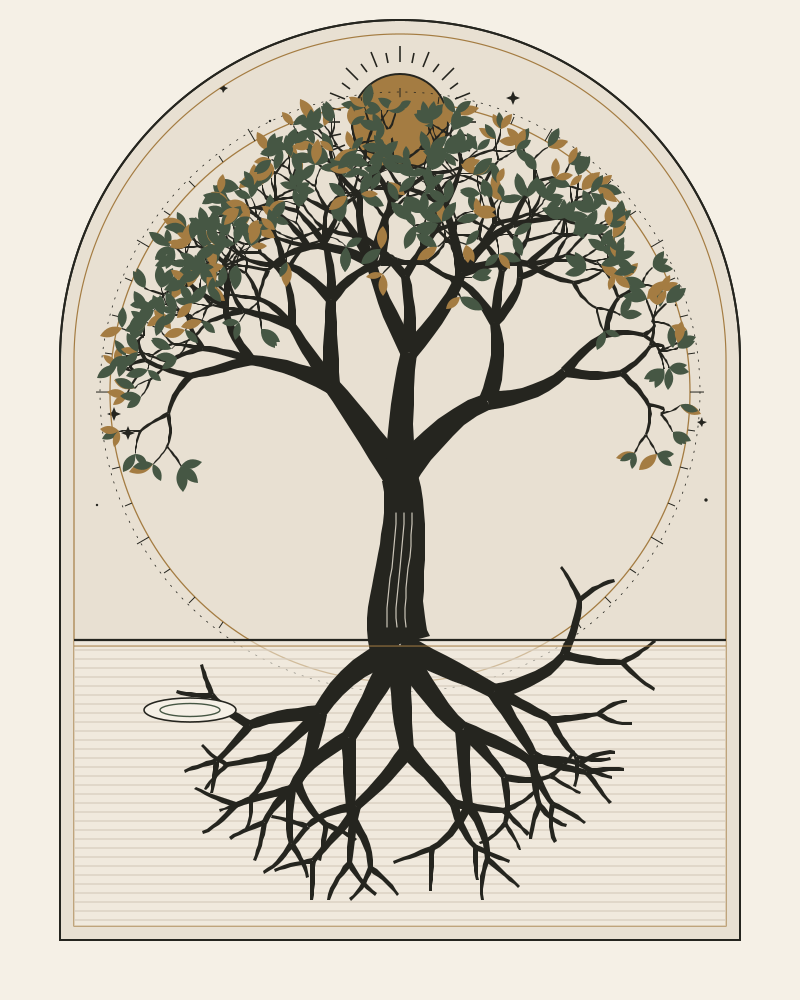
Engraved illustration of a great tree whose crown reaches a gold sun and starry sky, with its roots spreading below the horizon in mirror image.
Plate I The world tree: crown among the stars, roots beneath the earth.

I The traditions

Explore Mythologies

Begin with a tradition, then follow it back to the texts that preserve it. Eight are indexed here.

Browse all traditions

Norse · Scandinavia and Iceland

The ash tree, the nine worlds and the last battle

Norse myth is known mostly through two Icelandic sources set down in the thirteenth century: Snorri Sturluson's Prose Edda, a handbook for poets, and the anonymous poems of the Poetic Edda. Together they describe nine worlds held in the branches and roots of the ash Yggdrasil, gods who are told how their own story ends, and Ragnarök, the final battle after which the world is born again.

  1. Greek

    Greece and the Aegean · Homer and Hesiod, around the 8th to 7th century BCE

    Gods who quarrel, bargain and fall in love, told by poets who disagreed with one another.

  2. Egyptian

    The Nile valley · texts from the Pyramid Texts, around 2400 BCE, onward

    A cosmos kept in balance by ma'at, and a judgment of the dead that weighs the heart.

  3. Japanese

    Japan · the Kojiki (712 CE) and the Nihon Shoki (720 CE)

    Islands formed from brine dripping off a spear, and a sun goddess who hides in a cave.

  4. Irish and Celtic

    Ireland · medieval manuscripts that preserve older oral tradition

    A people who withdrew into the hills, and a hero who held a province against an army.

  5. Mesopotamian

    Sumer, Akkad, Babylon and Assyria · cuneiform tablets from the third millennium BCE

    A king who goes looking for immortality, and a goddess who descends to the underworld.

  6. Hindu

    South Asia · the Vedas, the Mahabharata, the Ramayana and the Puranas

    Cycles of creation and dissolution, and epics that are still retold and performed.

  7. Mesoamerican

    Maya and Nahua peoples · the K'iche' Popol Vuh and Nahua accounts

    Hero twins who outwit the lords of Xibalba, and people shaped from maize.

II The bestiary

Legendary Creatures

Every tradition keeps its monsters, and each one records what its storytellers feared, respected or hoped for. Four are shown here. The Creature Finder below searches all thirteen in the index.

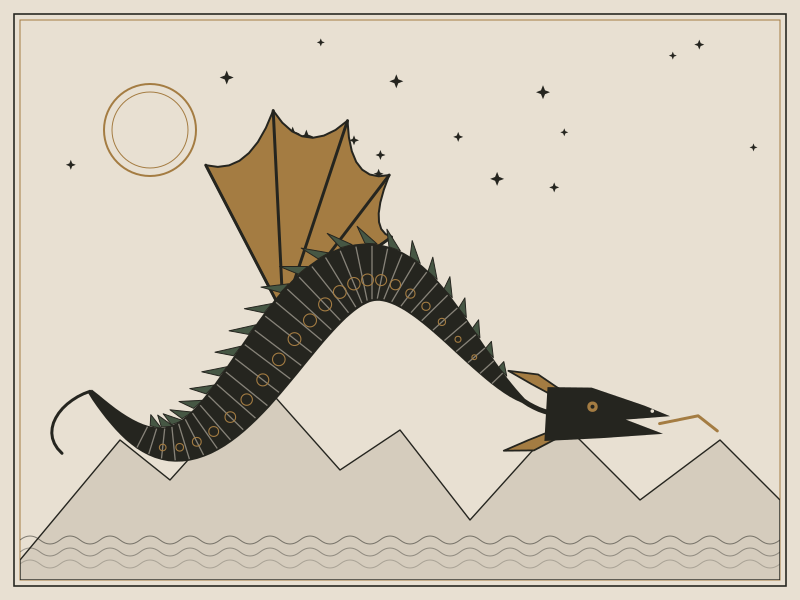
Engraved illustration of a winged dragon coiled across mountains beneath a gold sun and stars.

Dragons

European and Chinese traditions

European dragons such as Fáfnir hoard treasure and guard it to the death. The Chinese lóng governs rain and waters, and is usually a benevolent power. Same word in translation, nearly opposite creatures.

Read about dragons
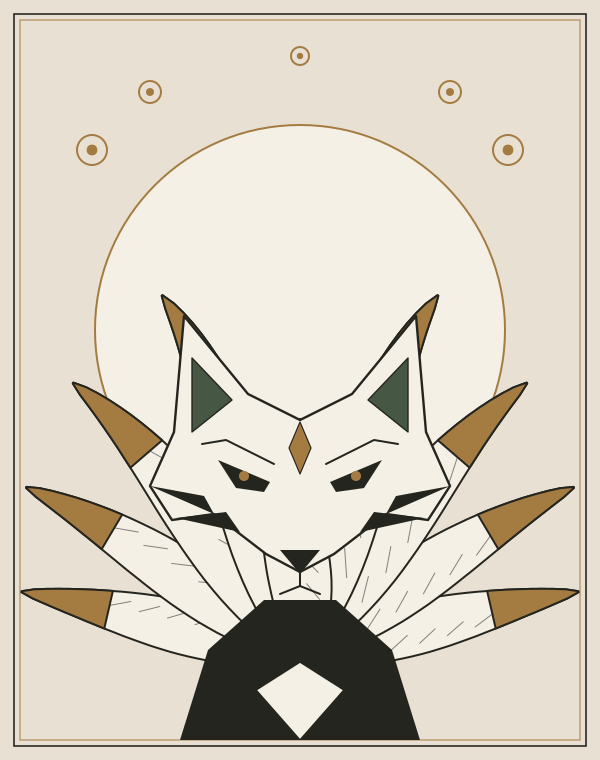
Engraved illustration of a fox spirit seen from the front, with nine gold-tipped tails fanned out behind it and spirit-fires floating above.

Kitsune

Japanese

A fox spirit that gains tails and power with age, up to nine. Kitsune appear as tricksters, as lovers in disguise and as messengers of the god Inari.

Read about kitsune
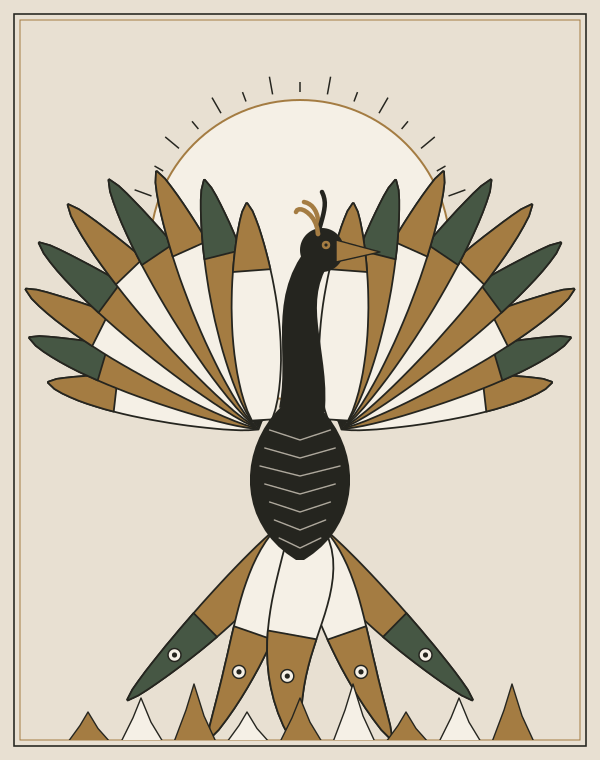
Engraved illustration of a phoenix with spread wings and long tail feathers before a halo of sun rays.

Phoenix

Greek, with Egyptian roots

A bird that burns and is reborn. Herodotus describes it in connection with Heliopolis, where the related Egyptian bennu bird was linked to the sun.

Read about the phoenix
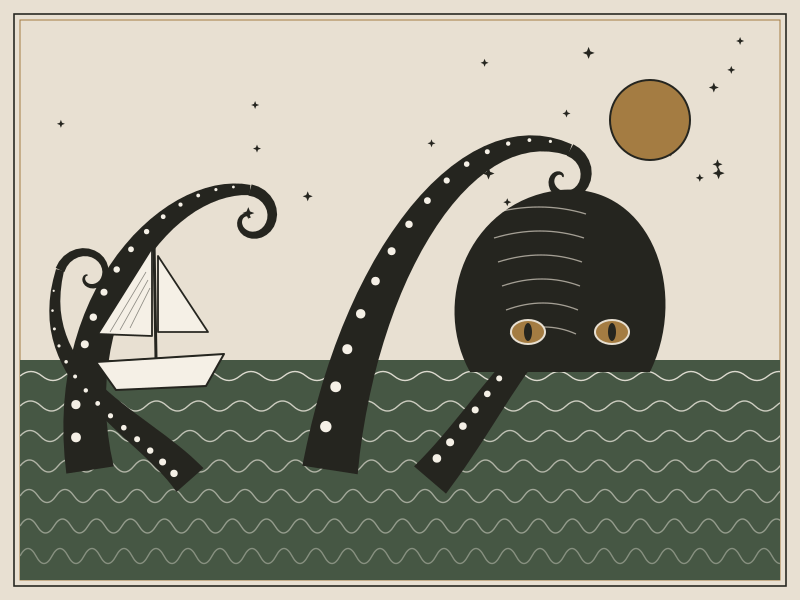
Engraved illustration of a sea monster rising from green waves, its tentacles curling above a small sailing ship under a gold moon.

Kraken

Scandinavian

A sea monster said to rise beneath ships off Norway and Iceland. Erik Pontoppidan described it in 1752, and Tennyson's poem on the subject followed in 1830.

Read about the kraken

The Creature Finder

Narrow the bestiary by where a creature lives and how it treats people. Temperament is a rough guide: many creatures are helpful in one story and dangerous in the next.

    III Stories worth retelling

    Folklore and Legends

    Myths belong to gods and cosmos; folklore belongs to villages, roads and kitchens. Both change with every telling.

    Retold from Snorri Sturluson's Prose Edda (about 1220)

    The Binding of Fenrir

    The gods raised the wolf Fenrir among them, and only Týr dared to feed him. As Fenrir grew, so did their dread, for it had been foretold that he would one day bring harm to Odin. They decided to bind him.

    Twice they set heavy chains before him and called it a contest of strength. Twice he broke them. So Odin sent a messenger to the dwarfs, who made a fetter as smooth and soft as a silk ribbon. Its name was Gleipnir.

    Fenrir was suspicious. A ribbon so slight must hide a trick, he said, and he would allow himself to be bound only if one of the gods placed a hand in his mouth as a pledge of good faith. None of the gods would, until Týr stepped forward.

    The more Fenrir struggled, the tighter Gleipnir held. The gods laughed, all except Týr, who lost his hand. Fenrir stays bound until Ragnarök, and the story is still remembered less as a victory than as a lesson in what a broken promise costs.

    What Gleipnir was made of

    1. The sound of a cat's footfall
    2. A woman's beard
    3. The roots of a mountain
    4. The sinews of a bear
    5. The breath of a fish
    6. The spittle of a bird

    Snorri adds that this is why such things cannot be found in the world.

    Read the longer retelling and its sources
    IV Make your own

    Worldbuilding Studio

    A world needs names, a map and a reason for its gods to quarrel. These tools offer starting points; they do not write the world for you. Everything runs in your browser, and nothing is saved or sent.

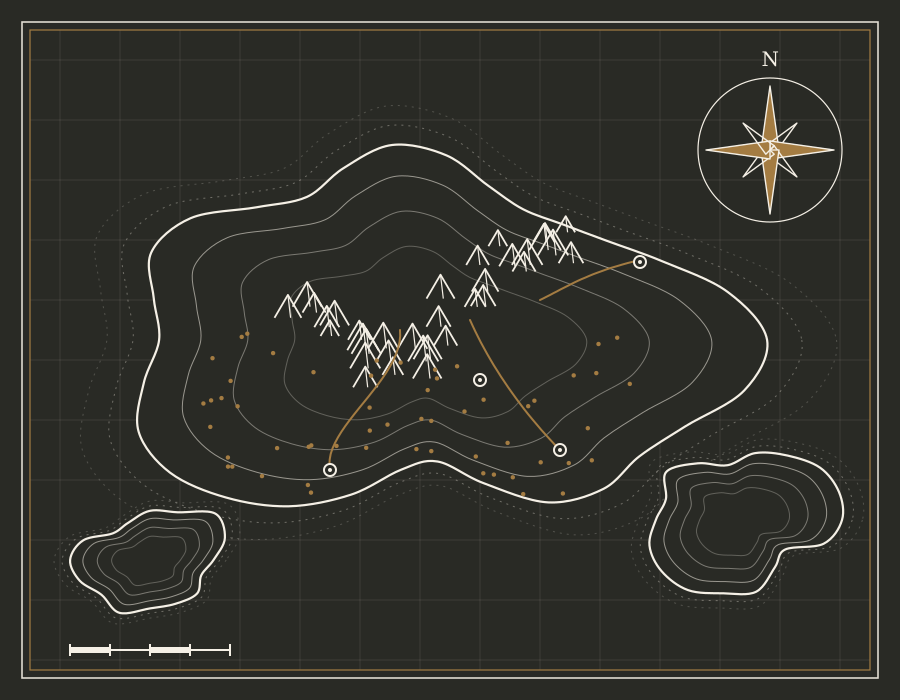
    Line-drawn fantasy map in pale ink on charcoal: a large continent with a mountain range, rivers and four settlements, two small islands, a compass rose and a scale bar.
    Plate IV A realm in outline: coast, range, rivers and four settlements.

    Name Forge

    Names built from sound patterns. The styles describe how a name sounds, not any real culture.

      Realm Seed

      Roll a four-part premise for a realm. Keep the parts you like and reroll the rest.

      V Study and test

      Mythology Learning Center

      Myths are texts before they are stories: someone wrote them down, in a language, for a reason. Learn the sources and the vocabulary, then test what stuck.

      Myth Quiz

      How to read a myth

      1. Ask who wrote it down, and when

        Many myths reach us through later writers with their own aims. Snorri, for instance, was writing a poetry handbook for Christian-era Icelanders.

      2. Separate the story from the commentary

        Translators and ancient authors often add explanations. Notice which lines tell the tale and which lines interpret it.

      3. Expect more than one version

        Variants are the norm, not errors. Compare tellings before deciding what a myth “really” says.

      Glossary

      Cosmogony
      An account of how the universe came into being.
      Theogony
      An account of the origin and descent of the gods. Hesiod's is the best known.
      Euhemerism
      The idea that gods began as real people, later remembered and exalted. Named for Euhemerus, who wrote around 300 BCE.
      Psychopomp
      A figure who guides souls to the afterlife, such as Hermes or Anubis.
      Kami
      The spirits and sacred presences honoured in Shinto.
      The Eddas
      Two Old Norse works: the Poetic Edda, a collection of poems, and the Prose Edda by Snorri Sturluson.
      Open the full glossary

      VI At the table

      RPG Toolkit

      Two tools for the table: a dice roller that takes full expressions, and an initiative tracker that keeps the round in order. Both are system-neutral.

      Dice Roller

      Examples: 1d20, 2d6+3, 4d8-1, 1d10+1d4+2. Up to 100 dice of up to 1000 sides.

      –

      Roll to see the result.

      Recent rolls

        No rolls yet.

        Initiative Tracker

        Round 1

          No combatants yet. Add a name and an initiative total to begin.

          VII From the editorial desk

          Latest Discoveries

          Essays and guides on sources, creatures and the craft of building worlds.

          Development note: article pages are pending implementation. Each link above opens a status page until the article is published.